
组合与设计模式
组合多步交易,理解 Daml 执行模型与隐私,并应用常见多方工作流模式
组合 choice
现在将把目前所学整合为完整、安全的资产发行、管理、转移与交易 Daml 模型。本应用能力类似 CN Quickstart。过程中还将学习:
- Daml 项目、包与模块
- 交易组合
- 观察方与 stakeholder
- Daml 执行模型
- 隐私
本节模型不是单个 Daml 文件,而是由多个相互依赖的文件组成的 Daml 项目。
Daml 项目
Daml 按项目、包与模块组织。Daml 项目用单个 daml.yaml 指定,编译为 Daml 中间语言(或字节码等价物)Daml-LF 中的包。项目内每个 .daml 文件成为一个 Daml 模块,类似命名空间。项目在 daml.yaml 的 source 参数指定源根目录,包包含该源目录下所有 *.daml 中的模块。
可在终端用 dpm new project-name 创建骨架项目。最小项目仅含 daml.yaml 与空的源文件目录。
查看本章项目的
daml.yaml:
sdk-version: __VERSION__
name: __PROJECT_NAME__
source: daml
version: 1.0.0
dependencies:
  - daml-prim
  - daml-stdlib
  - daml-script
name 与 version 一般可自由设置以描述项目。dependencies 即依赖列表,应始终包含 daml-prim 与 daml-stdlib:前者含编译器与 Daml Runtime 内部,后者提供标准库。daml-script 含 Daml Script 的类型与函数。
在项目根目录运行 dpm build 编译,生成 .daml/dist/dist/${project_name}-${project_version}.dar。DAR 类似 Java 的 JAR,是部署到账本以加载包及其依赖的产物。dar 文件自包含主包的全部依赖。更多见 构建与打包。
项目结构
本项目包含可转让、可拆分(fungible)资产的持仓模型,以及独立的交易工作流。模板分布在三个模块:Intro.Asset、Intro.Asset.Role、Intro.Asset.Trade。
测试位于 Test.Intro.Asset、Test.Intro.Asset.Role、Test.Intro.Asset.Trade。
模块名中除最后一段 . 分隔符外,各段对应项目源目录下的路径,最后一段为文件名。目录结构如下:
.
├── daml
│   ├── Intro
│   │   ├── Asset
│   │   │   ├── Role.daml
│   │   │   └── Trade.daml
│   │   └── Asset.daml
│   └── Test
│       └── Intro
│           ├── Asset
│           │   ├── Role.daml
│           │   └── Trade.daml
│           └── Asset.daml
└── daml.yaml
每个文件有模块头,例如 daml/Intro/Asset/Role.daml:
module Intro.Asset.Role where可用 import 导入模块。LibraryModules 导入全部六个模块:
import Intro.Assetimport 须紧接模块声明之后。可在 import 后列出名称以仅导入选定符号:
import DA.List (sortOn, groupOn)若模块含 Daml Script,须导入对应功能:
import Daml.Script项目概览
本项目在 授权 中的 Iou 模型上做了修改与扩展:
-
资产可通过
Merge、Splitchoice 由owner管理持仓,具有可合并、可拆分(fungible)特性。 -
转移提案现需
issuer与newOwner双方授权才能接受,从发行方角度看Asset比Iou更安全。在
Iou模型中,转移仅由owner与newOwner授权,发行方可能对任何人负债。本项目中只有持有AssetHolder合约的参与方才能成为资产持有人,发行方可控制谁可持有其资产。 -
Trade模板在模型中加入两种资产的互换。
组合 choice 与 script
本项目展示如何将 授权 中学到的 Update 与 Script action 付诸实践。例如 Merge、Split choice 的后果中各执行多个动作。
Split时两个 create 动作Merge时一个 create 与一个 archive 动作
choice Split
      : SplitResult
      with
        splitQuantity : Decimal
      controller owner
      do
        splitAsset <- create this with
          quantity = splitQuantity
        remainder <- create this with
          quantity = quantity - splitQuantity
        return SplitResult with
          splitAsset
          remainder

    choice Merge
      : ContractId Asset
      with
        otherCid : ContractId Asset
      controller owner
      do
        other <- fetch otherCid
        assertMsg
          "Merge failed: issuer does not match"
          (issuer == other.issuer)
        assertMsg
          "Merge failed: owner does not match"
          (owner == other.owner)
        assertMsg
          "Merge failed: symbol does not match"
          (symbol == other.symbol)
        archive otherCid
        create this with
          quantity = quantity + other.quantity
Split 中使用的 return 在任何 Action 上下文中可用。return x 的结果是不产生副作用、但携带值 x 的动作。别名 pure 表示纯值而非带副作用的值。当 return 作为 do 块最后一条语句时,其参数即为该 do 块的「返回值」。
进一步组合交易时,Trade 上的 Trade_Settle choice 组合两个 exercise 动作:
choice Trade_Settle
      : (ContractId Asset, ContractId Asset)
      with
        quoteAssetCid : ContractId Asset
        baseApprovalCid : ContractId TransferApproval
      controller quoteAsset.owner
      do
        fetchedBaseAsset <- fetch baseAssetCid
        assertMsg
          "Base asset mismatch"
          (baseAsset == fetchedBaseAsset with
            observers = baseAsset.observers)

        fetchedQuoteAsset <- fetch quoteAssetCid
        assertMsg
          "Quote asset mismatch"
          (quoteAsset == fetchedQuoteAsset with
            observers = quoteAsset.observers)

        transferredBaseCid <- exercise
          baseApprovalCid TransferApproval_Transfer with
            assetCid = baseAssetCid

        transferredQuoteCid <- exercise
          quoteApprovalCid TransferApproval_Transfer with
            assetCid = quoteAssetCid

        return (transferredBaseCid, transferredQuoteCid)
两层嵌套后果的交易可在 Test.Intro.Asset.Trade 的 test_trade script 中查看:
TX 14 1970-01-01T00:00:00Z (Test.Intro.Asset.Trade:79:23)
#14:0
│   disclosed to (since): 'Alice' (14), 'Bob' (14)
└─> 'Bob' exercises Trade_Settle on #12:0 (Intro.Asset.Trade:Trade)
          with
            quoteAssetCid = #9:1; baseApprovalCid = #13:1
    children:
    #14:1
    │   disclosed to (since): 'Alice' (14), 'Bob' (14), 'USD_Bank' (14)
    └─> 'Alice' and 'USD_Bank' fetch #10:1 (Intro.Asset:Asset)

    #14:2
    │   disclosed to (since): 'Alice' (14), 'Bob' (14), 'EUR_Bank' (14)
    └─> 'Bob' and 'EUR_Bank' fetch #9:1 (Intro.Asset:Asset)

    #14:3
    │   disclosed to (since): 'Alice' (14), 'Bob' (14), 'USD_Bank' (14)
    └─> 'Alice' and 'Bob' exercise TransferApproval_Transfer on #13:1 (Intro.Asset:TransferApproval)
                          with
                            assetCid = #10:1
        children:
        #14:4
        │   disclosed to (since): 'Alice' (14), 'Bob' (14), 'USD_Bank' (14)
        └─> 'Alice' and 'USD_Bank' fetch #10:1 (Intro.Asset:Asset)

        #14:5
        │   disclosed to (since): 'Alice' (14), 'Bob' (14), 'USD_Bank' (14)
        └─> 'Alice' and 'USD_Bank' exercise Archive on #10:1 (Intro.Asset:Asset)

        #14:6
        │   disclosed to (since): 'Alice' (14), 'Bob' (14), 'USD_Bank' (14)
        └─> 'Bob' and 'USD_Bank' create Intro.Asset:Asset
                                 with
                                   issuer = 'USD_Bank';
                                   owner = 'Bob';
                                   symbol = "USD";
                                   quantity = 100.0000000000;
                                   observers = []

    #14:7
    │   disclosed to (since): 'Alice' (14), 'Bob' (14), 'EUR_Bank' (14)
    └─> 'Alice',
        'Bob' exercises TransferApproval_Transfer on #11:1 (Intro.Asset:TransferApproval)
              with
                assetCid = #9:1
        children:
        #14:8
        │   disclosed to (since): 'Alice' (14), 'Bob' (14), 'EUR_Bank' (14)
        └─> 'Bob' and 'EUR_Bank' fetch #9:1 (Intro.Asset:Asset)

        #14:9
        │   disclosed to (since): 'Alice' (14), 'Bob' (14), 'EUR_Bank' (14)
        └─> 'Bob' and 'EUR_Bank' exercise Archive on #9:1 (Intro.Asset:Asset)

        #14:10
        │   disclosed to (since): 'Alice' (14), 'Bob' (14), 'EUR_Bank' (14)
        └─> 'Alice' and 'EUR_Bank' create Intro.Asset:Asset
                                   with
                                     issuer = 'EUR_Bank';
                                     owner = 'Alice';
                                     symbol = "EUR";
                                     quantity = 90.0000000000;
                                     observers = []
与 choice 类似,本项目 script 也彼此组合:
test_issuance = do
  setupResult@(alice, bob, bank, aha, ahb) <- setupRoles

  assetCid <- submit bank do
    exerciseCmd aha Issue_Asset
      with
        symbol = "USD"
        quantity = 100.0

  Some asset <- queryContractId bank assetCid
  assert (asset == Asset with
      issuer = bank
      owner = alice
      symbol = "USD"
      quantity = 100.0
      observers = []
        )

  return (setupResult, assetCid)
上例中 Test.Intro.Asset.Role 的 test_issuance script 使用同模块 setupRoles script 的输出。
同一行展示新的模式匹配:不必写 setupResult <- setupRoles 再用 _1、_2 访问分量,可直接命名。等价于:
setupResult <- setupRoles
case setupResult of
  (alice, bob, bank, aha, ahb) -> ...
仅写 (alice, bob, bank, aha, ahb) <- setupRoles 也合法,但 test_issuance 返回值用到 setupResult,故同时命名整体与分量。@ 记号可一次为整体与分量命名。
Daml 执行模型
Daml 执行模型较易理解,但有重要后果。可想象交易生命周期如下:
命令提交
用户通过参与方节点的 Ledger API 以托管在该节点的 Party 身份提交命令列表,该方称为 requester。
解释
每个命令对应一个或多个动作。此步骤在账本上下文中求值各动作对应的 Update,计算全部后果(含传递性后果),得到完整交易。交易与其 requester 合称 commit。
脱敏 在强隐私账本上,为所有相关方创建投影(见 隐私模型),亦称 projecting。
交易提交 将交易/commit 提交到网络。
验证 网络验证交易/commit;具体验证者因实现而异。验证还包括调度与冲突检测,保证交易在 commit 的(偏)序中有明确位置且无双花。
承诺 按账本的 commit 或共识协议实际提交 commit。
确认 网络向所有相关参与方节点发回承诺确认。
完成 用户通过提交参与方节点的 Ledger API 收到确认。
首要后果:所有交易原子提交——要么全体参与方整体提交,要么失败。
这对上文 Trade_Settle choice 很重要:choice 将 baseAsset 与 quoteAsset 各向一方转移,交易原子性保证任一方不会只出不进。
第二后果:交易 requester 知晓其提交交易的全部后果——Daml 中无「意外」。但也意味着 requester 须具备解释交易的全部信息,下文亦称原则 2。
这对 Trade 也很重要:为使 Bob 能解释将 Alice 资金转给 Bob 的交易,Bob 须知晓 Alice 的 Asset 合约,以及 Alice 接受转移的方式——本例中接受转移需要 issuer 权限。
观察方
观察方 是 Daml 向其他参与方披露合约的机制。声明方式与 signatory 类似,但用 observer 关键字,见 Asset 模板:
template Asset
  with
    issuer : Party
    owner : Party
    symbol : Text
    quantity : Decimal
    observers : [Party]
  where
    signatory issuer, owner
    ensure quantity > 0.0

    observer observers
Asset 模板还给 owner 设置观察方的 choice;可见 Alice 在提议交易前用其向 Bob 展示 Asset。可尝试删除该交易观察后果:
usdCid <- submit alice do
    exerciseCmd usdCid SetObservers with
      newObservers = [bob]
观察方在 Daml 中有保证:尤其保证能看到其作为 observer 的合约上的创建与归档动作。
因观察方由合约参数计算,他们彼此知晓。因此 Alice 不在 AssetHolder 上加 Bob 为 observer 并在 Trade_Settle 中用其授权转移,而是创建一次性的 TransferAuthorization。若 Alice 有许多对手方,否则他们会彼此泄露。
Choice controller 不会自动成为 observer,因其仅在 choice 参数已知时才能计算。
隐私
Daml 隐私模型基于两条原则:
原则 1. 参与方看到与其有利害关系的动作。原则 2. 看到某动作的参与方看到其(传递)后果。
原则 2 保证各方能独立验证所见每笔交易的有效性。
参与方对动作有利害关系若:
- 是该动作的必需授权方
- 是被执行动作合约的 signatory
- 是该合约的 observer,且动作为创建或归档
对 test_trade 中 exercise tradeCid Trade_Settle 意味着什么?
Alice 是 tradeCid 的 signatory,Bob 是 Trade_Settle 动作的必需授权方,故二者均可见。按原则 2,他们看到交易内一切。
后果中除若干 fetch 外,有两个 TransferApproval_Transfer choice 的 exercise 动作。
两个 TransferApproval 合约由不同 issuer 签署,各自看到「自己」合约上的动作。故 EUR_Bank 看到 EUR Asset 的 TransferApproval_Transfer,USD_Bank 看到 USD Asset 的对应动作。
部分 Daml 账本(如 script runner 与 Sandbox)遵循「数据最小化」,仅分发上述信息。即分发给 EUR_Bank 的整体交易「投影」(execution_model 第 4 步)仅含 TransferApproval_Transfer 及其后果。
其他实现(尤其公链)隐私约束可能更弱。
泄露(Divulgence)
隐私模型原则 2 意味着参与方有时能看到并非 signatory 或 observer 的合约。例如 test_trade script 最终账本状态中,Alice 与 Bob 均看到两种资产(各自列中的 X):
| Alice | Bob | EUR_Bank | USD_Bank | id | status | issuer | owner | symbol | quantity |
|---|---|---|---|---|---|---|---|---|---|
| X | X | - | X | #15:6 | active | USD_Bank | Bob | USD | 100.0 |
| X | X | X | - | #15:10 | active | EUR_Bank | Alice | EUR | 90.0 |
因这些合约的 create 动作在双方有利害关系的 Trade_Settle 的传递后果中。此类披露常称「divulgence」,设计隐私敏感应用时须考虑。
常见 Daml 设计模式
除上文组合模式外,本节介绍 Daml 中常见的多方工作流模式。以下示例均用 Coin 资产模型说明。
提议-接受(Propose-Accept)
多方就共享合约达成一致的最常见方式:一方创建提案合约,另一方接受、拒绝或任其过期。授权模块 中的 IouProposal 也是此模式。
发行方创建 CoinMaster,再邀请持有人。邀请为提案合约,发行方为 signatory,持有人为 observer:
template CoinMaster
  with
    issuer: Party
  where
    signatory issuer

    nonconsuming choice Invite : ContractId CoinIssueProposal
      with owner: Party
      controller issuer
      do create CoinIssueProposal
            with coinAgreement = CoinIssueAgreement with issuer; owner
提案给持有人接受 choice。完整模型还可含 Reject、Counter:
template CoinIssueProposal
  with
    coinAgreement: CoinIssueAgreement
  where
    signatory coinAgreement.issuer
    observer coinAgreement.owner

    choice AcceptCoinProposal
      : ContractId CoinIssueAgreement
      controller coinAgreement.owner
      do create coinAgreement
持有人接受后,结果合约双方均为 signatory——未经同意任何一方不会被强制进入协议:
template CoinIssueAgreement
  with
    issuer: Party
    owner: Party
  where
    signatory issuer, owner

    nonconsuming choice Issue : ContractId Coin
      with amount: Decimal
      controller issuer
      do create Coin with issuer; owner; amount; delegates = []
需要两方以上签名时此模式可能冗长——见下文多方协议。
委托(Delegation)
一方有权代表另一方 exercise choice。Principal 创建委托合约,授权 agent 代为行动,principal 不必逐笔授权。这对应银行托管证券并代客户结算等关系。
委托合约(CoinPoA — 授权书)以 principal 为 signatory。Attorney 控制 TransferCoin choice,在 principal 的 coin 上 exercise Transfer:
template CoinPoA
  with
    attorney: Party
    principal: Party
  where
    signatory principal
    observer attorney

    choice WithdrawPoA
      : ()
      controller principal
      do return ()

    -- Attorney has the delegated right to Transfer
    nonconsuming choice TransferCoin
      : ContractId TransferProposal
      with
        coinId: ContractId Coin
        newOwner: Party
      controller attorney
      do
        exercise coinId Transfer with newOwner
Attorney exercise 委托 choice 前须披露 coin,可通过 Coin 上 Disclose choice 将其加为 observer:
choice Disclose : ContractId Coin
      with p : Party
      controller owner
      do create this with delegates = p :: delegates
授权(Authorization)
在采取某些动作前验证控制方具备权限。授权合约作为证明——choice 体检查其存在与有效性。
例如发行方只希望经认可的参与方接收 coin 转移。发行方为获准 owner 创建授权 token:
template CoinOwnerAuthorization
  with
    owner: Party
    issuer: Party
  where
    signatory issuer
    observer owner

    choice WithdrawAuthorization
      : ()
      controller issuer
      do return ()
TransferProposal 的 AcceptTransfer 要求新 owner 提供授权 token,assert 验证 token 的 issuer 与 new owner:
choice AcceptTransfer
      : ContractId Coin
      with token: ContractId CoinOwnerAuthorization
      controller newOwner
      do
        t <- fetch token
        assert (coin.issuer == t.issuer)
        assert (newOwner == t.owner)
        create coin with owner = newOwner
若发行方在转移被接受前撤回授权,转移失败。
锁定(Locking)
合约处于锁定状态时阻止 exercise choice。适用于清算期间冻结资产等场景。
一种做法是通过状态变更锁定——合约带 locker 字段。owner == locker 时未锁定可转移;否则由第三方 locker 控制解锁:
template LockableCoin
  with
    owner: Party
    issuer: Party
    amount: Decimal
    locker: Party
  where
    signatory issuer, owner
    observer locker

    ensure amount > 0.0

    -- Transfer can only happen if not locked
    choice Transfer : ContractId TransferProposal
      with newOwner: Party
      controller owner
      do
        assert (locker == owner)
        create TransferProposal with coin=this; newOwner

    -- Lock by bringing a locker on board
    choice Lock : ContractId LockableCoin
      with newLocker: Party
      controller owner
      do
        assert (newLocker /= owner)
        create this with locker = newLocker

    -- Unlock restores owner control
    choice Unlock
      : ContractId LockableCoin
      controller locker
      do
        assert (locker /= owner)
create this with locker = owner另有通过归档锁定(归档原合约并创建带 Unlock、Clawback 的 LockedCoin 包装)与通过托管锁定(将托管交给可信第三方由其控制解锁)。
多方协议(Multiple party agreement)
收集两方以上签名。Pending 合约包装最终 Agreement 并跟踪已签方。各方通过 Sign choice 签署,全部签署后任一方可 Finalize 创建协议。
最终协议合约有多名 signatory:
template Agreement
  with
    signatories: [Party]
  where
    signatory signatories
    ensure unique signatories
Pending 合约逐个收集签名。所有必需 signatory 可观察,故各方可知何时轮到自己:
toSign : Pending -> [Party]
toSign Pending { alreadySigned, finalContract } =
  filter (`notElem` alreadySigned) finalContract.signatories

template Pending
  with
    finalContract: Agreement
    alreadySigned: [Party]
  where
    signatory alreadySigned
    observer finalContract.signatories
    ensure unique alreadySigned

    choice Sign : ContractId Pending with
        signer : Party
      controller signer
        do
          assert (signer `elem` toSign this)
          create this with alreadySigned = signer :: alreadySigned

    choice Finalize : ContractId Agreement with
        signer : Party
      controller signer
        do
          assert (sort alreadySigned == sort finalContract.signatories)
          create finalContract
一方通过创建仅将自己列为已签的 Pending 启动工作流。其他人任意顺序签署,完成后任一 signatory 可 finalize:
-- Any party can kick off by creating a Pending listing only themselves
pending <- person1 `submit` do
  createCmd Pending with finalContract; alreadySigned = [person1]

-- Each party signs
pending <- person2 `submit` do exerciseCmd pending Sign with signer = person2
pending <- person3 `submit` do exerciseCmd pending Sign with signer = person3
pending <- person4 `submit` do exerciseCmd pending Sign with signer = person4

-- Once all have signed, any signatory can finalize
person1 `submit` do exerciseCmd pending Finalize with signer = person1
组合 choice
现在将把目前所学整合为完整、安全的资产发行、管理、转移与交易 Daml 模型。本应用能力类似 CN Quickstart。过程中还将学习:
- Daml 项目、包与模块
- 交易组合
- 观察方与 stakeholder
- Daml 执行模型
- 隐私
本节模型不是单个 Daml 文件,而是由多个相互依赖的文件组成的 Daml 项目。
Daml 项目
Daml 按项目、包与模块组织。Daml 项目用单个 daml.yaml 指定,编译为 Daml-LF 包。项目内每个 .daml 文件成为一个模块。源根由 daml.yaml 的 source 指定。
可在终端用 dpm new project-name 创建骨架。最小项目仅含 daml.yaml 与空源目录。
查看本章项目的
daml.yaml:
-- Code from: daml/daml-intro-compose/daml.yaml.template
-- [Include actual code example here]
name 与 version 可自由设置。dependencies 须包含 daml-prim、daml-stdlib 与 daml-script。
在项目根运行 dpm build 生成 DAR。更多见 构建与打包。
项目结构
本项目含可转让 fungible 资产持仓模型与独立交易工作流。模板在 Intro.Asset、Intro.Asset.Role、Intro.Asset.Trade;测试在对应 Test.Intro.* 模块。目录结构:
.
├── daml
│   ├── Intro
│   │   ├── Asset
│   │   │   ├── Role.daml
│   │   │   └── Trade.daml
│   │   └── Asset.daml
│   └── Test
│       └── Intro
│           ├── Asset
│           │   ├── Role.daml
│           │   └── Trade.daml
│           └── Asset.daml
└── daml.yaml
每个文件含模块头,例如 daml/Intro/Asset/Role.daml:
-- Code from: daml/daml-intro-compose/daml/Intro/Asset/Role.daml
-- [Include actual code example here]
可用 import 导入模块:
-- Code from: daml/daml-intro-compose/daml/Intro/Asset/Role.daml
-- [Include actual code example here]
import 须紧接模块声明。可 selective import:
import DA.List (sortOn, groupOn)含 Daml Script 时须:
import Daml.Script项目概览
本项目扩展 授权 中的 Iou 模型:Merge/Split、双方授权的转移、以及 Trade 互换两种资产。
组合 choice 与 script
展示 授权 中 Update 与 Script 的用法。Merge、Split 后果含多个动作。
-- Code from: daml/daml-intro-compose/daml/Intro/Asset.daml
-- [Include actual code example here]return/pure 在 Action 中用法同上。
Trade_Settle 组合两个 exercise:
-- Code from: daml/daml-intro-compose/daml/Intro/Asset/Trade.daml
-- [Include actual code example here]
交易树见 Test.Intro.Asset.Trade 的 test_trade:
TX 14 1970-01-01T00:00:00Z (Test.Intro.Asset.Trade:79:23)
#14:0
│   disclosed to (since): 'Alice' (14), 'Bob' (14)
└─> 'Bob' exercises Trade_Settle on #12:0 (Intro.Asset.Trade:Trade)
          with
            quoteAssetCid = #9:1; baseApprovalCid = #13:1
    children:
    #14:1
    │   disclosed to (since): 'Alice' (14), 'Bob' (14), 'USD_Bank' (14)
    └─> 'Alice' and 'USD_Bank' fetch #10:1 (Intro.Asset:Asset)

    #14:2
    │   disclosed to (since): 'Alice' (14), 'Bob' (14), 'EUR_Bank' (14)
    └─> 'Bob' and 'EUR_Bank' fetch #9:1 (Intro.Asset:Asset)

    #14:3
    │   disclosed to (since): 'Alice' (14), 'Bob' (14), 'USD_Bank' (14)
    └─> 'Alice' and 'Bob' exercise TransferApproval_Transfer on #13:1 (Intro.Asset:TransferApproval)
                          with
                            assetCid = #10:1
        children:
        #14:4
        │   disclosed to (since): 'Alice' (14), 'Bob' (14), 'USD_Bank' (14)
        └─> 'Alice' and 'USD_Bank' fetch #10:1 (Intro.Asset:Asset)

        #14:5
        │   disclosed to (since): 'Alice' (14), 'Bob' (14), 'USD_Bank' (14)
        └─> 'Alice' and 'USD_Bank' exercise Archive on #10:1 (Intro.Asset:Asset)

        #14:6
        │   disclosed to (since): 'Alice' (14), 'Bob' (14), 'USD_Bank' (14)
        └─> 'Bob' and 'USD_Bank' create Intro.Asset:Asset
                                 with
                                   issuer = 'USD_Bank';
                                   owner = 'Bob';
                                   symbol = "USD";
                                   quantity = 100.0000000000;
                                   observers = []

    #14:7
    │   disclosed to (since): 'Alice' (14), 'Bob' (14), 'EUR_Bank' (14)
    └─> 'Alice',
        'Bob' exercises TransferApproval_Transfer on #11:1 (Intro.Asset:TransferApproval)
              with
                assetCid = #9:1
        children:
        #14:8
        │   disclosed to (since): 'Alice' (14), 'Bob' (14), 'EUR_Bank' (14)
        └─> 'Bob' and 'EUR_Bank' fetch #9:1 (Intro.Asset:Asset)

        #14:9
        │   disclosed to (since): 'Alice' (14), 'Bob' (14), 'EUR_Bank' (14)
        └─> 'Bob' and 'EUR_Bank' exercise Archive on #9:1 (Intro.Asset:Asset)

        #14:10
        │   disclosed to (since): 'Alice' (14), 'Bob' (14), 'EUR_Bank' (14)
        └─> 'Alice' and 'EUR_Bank' create Intro.Asset:Asset
                                   with
                                     issuer = 'EUR_Bank';
                                     owner = 'Alice';
                                     symbol = "EUR";
                                     quantity = 90.0000000000;
                                     observers = []
script 亦彼此组合:
-- Code from: daml/daml-intro-compose/daml/Test/Intro/Asset/Role.daml
-- [Include actual code example here]
test_issuance 使用 setupRoles 输出;@ 记号同时命名元组整体与分量。
Daml 执行模型
交易生命周期:命令提交 → 解释(计算 Update 后果)→ 脱敏(强隐私账本)→ 提交 → 验证 → 承诺 → 确认 → 完成。原子性与 requester 知晓全部后果(原则 2)对 Trade_Settle、Trade 中 Bob 须知晓 Alice 资产与转移授权尤为关键。
观察方
用 observer 披露合约;SetObservers 示例同上。观察方保证见创建/归档;不宜用 AssetHolder observer 授权 Trade_Settle,宜用一次性 TransferAuthorization。
-- Code from: daml/daml-intro-compose/daml/Intro/Asset.daml
-- [Include actual code example here]
-- Code from: daml/daml-intro-compose/daml/Test/Intro/Asset/Trade.daml
-- [Include actual code example here]隐私
原则 1:见有利害关系的动作。原则 2:见动作则见其传递后果。对 Trade_Settle,Alice/Bob 见全交易;各银行只见各自 TransferApproval_Transfer。Sandbox 等遵循数据最小化投影。
泄露(Divulgence)
原则 2 下参与方有时可见非 signatory/observer 合约。test_trade 最终状态示例:
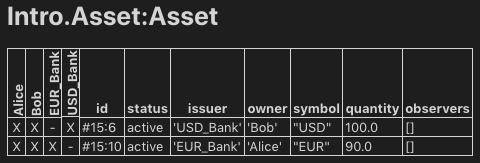
因 create 在双方有利害关系的 Trade_Settle 传递后果中。设计隐私敏感模型时须考虑 divulgence。
下一步
在异常处理章节将学习如何在 Daml 中处理模型错误。
本文由 CC Privacy Club 根据 Canton Network 官方文档(CC-BY-4.0)整理翻译,仅供学习;实现细节以官方最新版本为准。